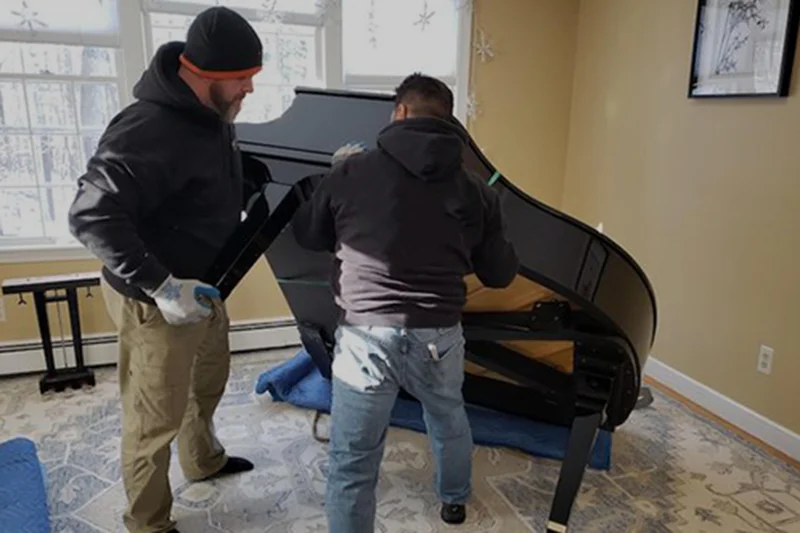

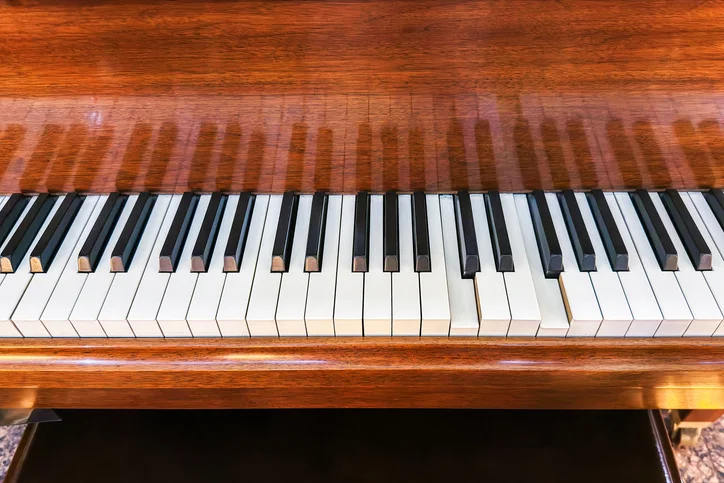
Few things are more frustrating to a pianist than a key that hesitates, feels sluggish, or simply refuses to return the way it should.
A sticky piano key can feel like a mechanical failure, and sometimes it is. But in many cases, especially when the problem appears seasonally, the real culprit may be something much simpler: humidity.
Acoustic pianos are built largely from natural materials, including wood, felt, leather, cloth and metal. These materials react to changes in temperature and moisture. As humidity rises and falls throughout the year, parts of the piano can expand, contract and shift slightly.
Those changes may be small, but inside a precisely regulated instrument, even a small amount of movement can affect how the keys and action perform.
Understanding how humidity affects your piano can help prevent sticking keys, tuning instability and more serious long-term problems.
When you press a piano key, you are setting an entire mechanical system into motion.
The key activates a complex series of wooden, felted and mechanical components known as the piano action. These parts must move freely and return to their resting positions smoothly.

When humidity becomes excessive, wooden components can absorb moisture from the air and swell slightly. Felt bushings and other materials within the action can also change dimension.
The result may be keys that feel sluggish, keys that are slow to return, uneven resistance from one key to another, an action that feels heavier than usual, or keys that occasionally stick altogether.
If several keys begin behaving differently during a particularly humid period, the environment surrounding the piano may be contributing to the problem.
For most acoustic pianos, maintaining a relative humidity level of approximately 40% to 50% is an excellent target.

The key word, however, is stability.
A piano generally responds better to an environment that remains reasonably consistent than one that repeatedly swings from very dry to very humid.
A broader range of approximately 35% to 70% relative humidity may be tolerated, but conditions toward either extreme should not become the normal environment for the instrument.
When humidity rises well above the preferred range, wood components may swell and the action may become sluggish.
When humidity becomes too low, the opposite can occur. Wood loses moisture and shrinks, which can contribute to tuning instability, loosened components and, in severe cases, cracking.
For that reason, piano owners should think less about achieving one perfect number every hour of every day and more about avoiding prolonged extremes and dramatic seasonal swings.
In New Jersey and throughout the Northeast, summer humidity can be particularly challenging for acoustic pianos.
Warm outdoor air often carries a great deal of moisture. Even in air-conditioned homes, humidity levels can fluctuate depending on weather conditions, ventilation, open windows and doors, basement moisture and the home’s HVAC system.

As humidity rises, a piano’s wooden and felt components can absorb that moisture.
This is one reason some piano owners notice that their instrument feels wonderful during one part of the year but becomes heavier or less responsive during another.
A key that seems perfectly normal in January may suddenly begin sticking in July or August.
The piano has not necessarily developed a major defect. It may simply be reacting to its environment.
Winter can create a different challenge.
Heating systems remove moisture from indoor air, sometimes causing relative humidity inside a home to fall significantly.

Extremely dry conditions can affect the soundboard, pinblock, bridges and action components. Over time, repeated cycles of expansion and contraction place additional stress on the materials inside the piano.
This is why climate control should be viewed as a year-round piano care issue, not merely a summertime concern.
Summer humidity can create swelling and sluggishness. Winter dryness can create shrinkage and instability.
The goal is to minimize both.
Before buying any additional equipment, take a look at the technology already in your home.
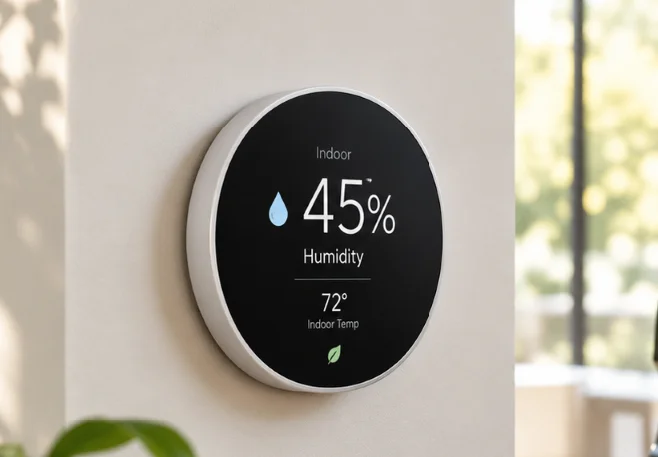
Many newer smart thermostats, including the Google Nest Thermostat and Nest Learning Thermostat, include built-in humidity sensing and can provide homeowners with useful information about indoor relative humidity.
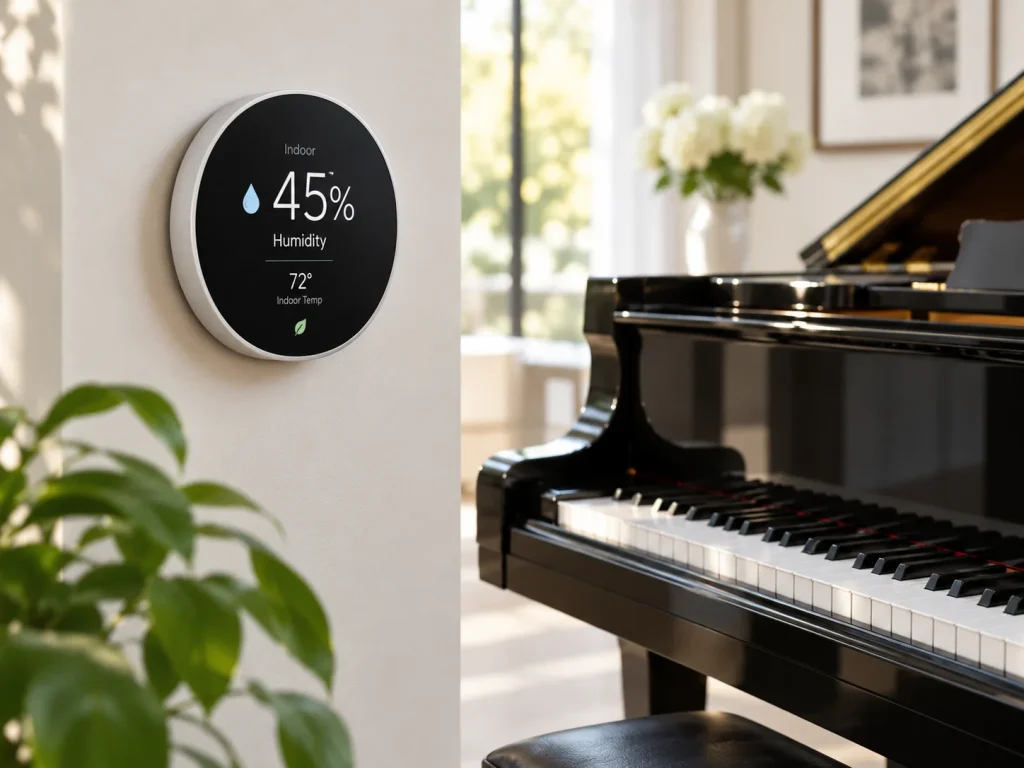
If your thermostat is located in the same room, or reasonably close to your piano, checking that humidity reading can be an easy first step in understanding the environment around the instrument.
This is especially useful during very humid summer weather and dry winter heating months.
For most acoustic pianos, a relative humidity level around 40% to 50% remains a strong target.
The advantage of a smart thermostat is convenience. Rather than guessing whether the house feels humid, you may already have a device in your home continuously monitoring indoor conditions.
However, thermostat location matters.
A thermostat in a hallway on the first floor may not accurately represent the conditions surrounding a piano located in a second-floor music room, finished basement, sunroom or another part of the house.
In those situations, an inexpensive digital hygrometer placed near the piano can provide a more accurate room-specific measurement.
The important thing is not which device you use. It is knowing the actual humidity surrounding your piano and watching for large seasonal swings.
If your smart thermostat is not located close to the piano, a small digital hygrometer can be one of the simplest and most useful piano-care tools you can own.
A hygrometer measures relative humidity in the immediate area where it is placed.
Set one near the piano and check it regularly, particularly during major seasonal changes.
If the reading consistently moves outside a comfortable range, you can take steps to stabilize the room.
During humid conditions, that may mean using air conditioning or a dehumidifier.
During very dry winter months, a room humidifier may help bring moisture back into the air.
In homes where room humidity is difficult to control, a dedicated piano climate-control system may provide another option.
Systems such as those manufactured by Dampp-Chaser are designed specifically to help maintain a more consistent microclimate within the piano.
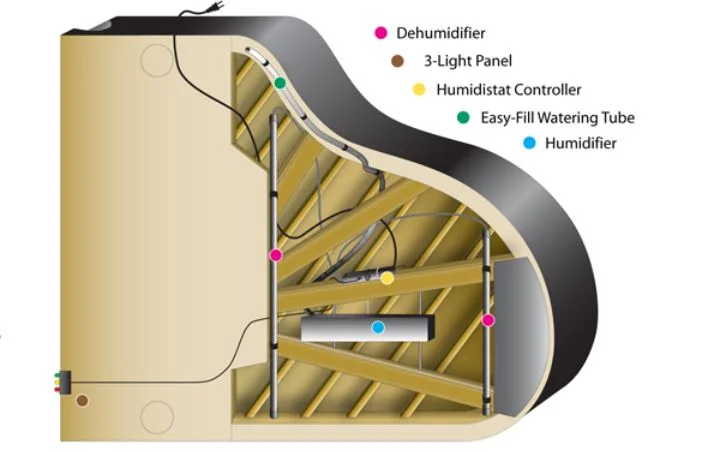
These systems can include humidifying and dehumidifying components that respond as conditions change.
They do not replace proper home climate control or routine piano service, but they may be especially helpful in homes where humidity varies substantially throughout the year.
A qualified piano technician can determine whether this type of system is appropriate for your particular piano and environment.
Humidity is not the only environmental factor that can affect a piano.
Placement within the home can make a meaningful difference.
Whenever possible, avoid positioning an acoustic piano directly beside heating vents, forced-air registers, fireplaces, wood stoves, drafty exterior doors or other areas subject to rapid temperature changes.

Prolonged direct sunlight can also create unnecessary heat and environmental fluctuation.
The ideal piano location is one where temperature and humidity remain reasonably stable throughout the year.
Modern homes are generally much better climate-controlled than older homes, so the old rule that a piano should never be placed near an exterior wall is not universally applicable.
The real concern is not the wall itself. It is environmental stability.
Although humidity is a common contributor, it is not the only reason piano keys stick.
A sticking or sluggish key may also be caused by worn or swollen key bushings, action components rubbing against one another, improper regulation, debris between keys, loose or misaligned parts, or simply normal wear after years of use.
Occasionally, a foreign object can even find its way between the keys or into the action.
Piano actions contain thousands of individual parts working together within extremely small tolerances.

For that reason, trying to force, lubricate or disassemble a sticking key without understanding the mechanism can easily make the problem worse.
If the problem continues after indoor humidity has returned to a normal range, it is best to have the piano inspected by a qualified piano technician.
Like any precision instrument, a piano performs best when it receives consistent care.
Regular tuning, proper regulation, appropriate cleaning and a stable indoor environment all contribute to the instrument’s performance and longevity.
Humidity control is particularly important because it affects far more than just the keys.
Large swings in moisture can influence tuning stability, action performance, wooden components and the overall condition of the instrument.
Fortunately, monitoring your piano’s environment has never been easier.

Your Google Nest Thermostat or other smart thermostat may already provide a useful indoor humidity reading. A small digital hygrometer can give you an even more localized measurement. And where larger fluctuations remain a problem, room climate control or a dedicated piano humidity-control system may provide additional protection.
If your piano keys begin to feel sticky or sluggish, do not automatically assume something serious has gone wrong.
Sometimes your piano is simply telling you that the room around it has changed.
At B Natural Pianos, we have spent decades helping piano owners understand, maintain and enjoy their instruments. For more information about tuning, humidity, regulation, cleaning and long-term piano maintenance, visit our Piano Care Guide.
A well-maintained piano does more than stay in tune. It feels better, sounds better and remains enjoyable to play for generations.